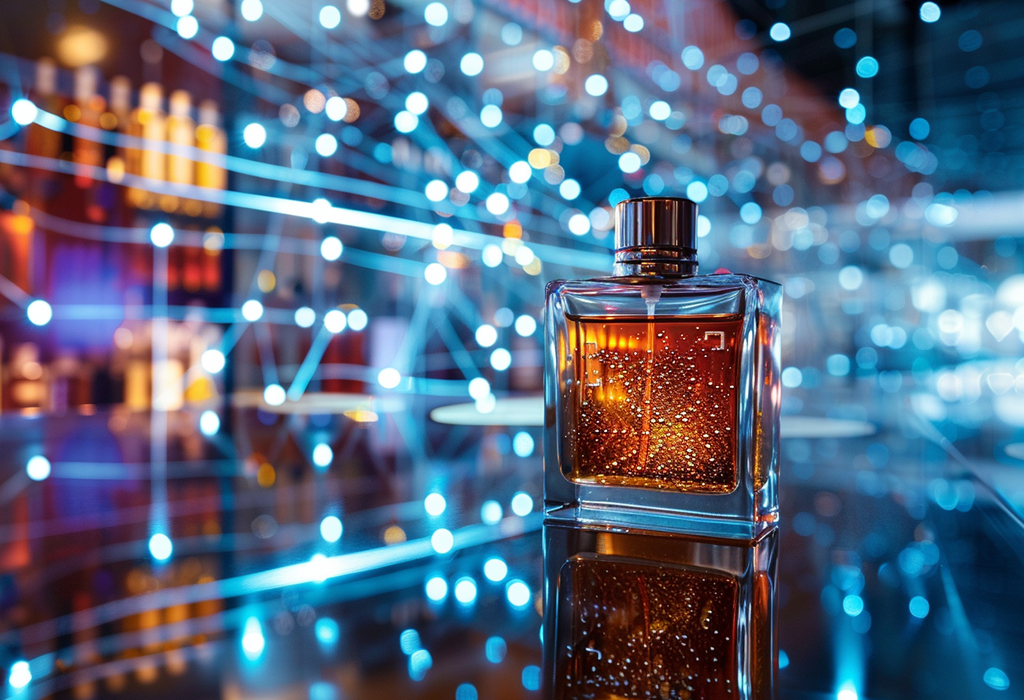
The ancient art of perfumery has a new apprentice. Artificial intelligence now designs fragrances for major luxury brands, analyzing millions of formulas and predicting scent combinations that human noses might never attempt. The transformation happened quietly, but the impact is reshaping a 200-year-old industry.
Every major fragrance house now uses AI in its creative process. Givaudan, Symrise, DSM-Firmenich, and IFF have all developed proprietary systems that assist perfumers in creating new scents. What once took months of trial and error can now happen in days. The first AI-designed perfumes launched in Brazil in 2019, and by 2023, all perfumers at major scent companies started routinely using AI when working on formulas.
How the Technology Works
Symrise partnered with IBM Research to create Philyra, an AI system that analyzes 3.5 million legacy formulas and over 2,000 raw materials across 20 dimensions. The system examines fragrance families, regional preferences, sales data, and chemical compatibility to suggest novel combinations. A master perfumer can then refine these suggestions, adjusting specific notes and improving how long the scent lasts on skin.
Givaudan developed Carto, an interactive touchscreen system that visualizes scent combinations in real time. A connected robot instantly creates physical samples using real ingredients, allowing perfumers to test ideas at speeds impossible with traditional methods. The system cross-references market research, chemistry data, customer preferences, and historical formulas to suggest unexpected ingredient pairings.
DSM-Firmenich built Scentmate to democratize fragrance creation for smaller brands. The platform uses AI to craft fragrances that evoke specific emotional responses, aligning scent profiles with consumer moods and preferences. IFF employs AI in its Science of Wellness program, focusing on creating fragrances that contribute to wellbeing by analyzing the psychological effects of scent components.
Real Products on Store Shelves
The technology has moved beyond laboratory experiments. In June 2019, Brazilian cosmetics company O Boticário launched Egeo On Me and Egeo On You, the first perfumes created with AI assistance. Symrise perfumer David Apel, who worked on the project, called the AI suggestions surprising. Philyra proposed replacing hay absolute in the masculine fragrance with warm chai latte infused with cardamom and fenugreek, a pairing Apel would never have dared use for an aromatic fougère.
Swedish beauty company Oriflame collaborated with Symrise to create three fragrances using Philyra as a creative partner. The AI functioned like a recommendation algorithm, merging draft formulas from perfumers with its understanding of nostalgia, awe, and cosmic wonder. The resulting scents, Time Loop, Earth Wonder, and Across Space, now sell under the company’s AI co-created line.
Tom Ford’s Bois Pacifique fragrance was developed using AI, marking Estée Lauder’s entry into algorithmic perfume formulation. Paco Rabanne’s Phantom cologne incorporated AI in its development process, though the brand has since stopped emphasizing the technology in its marketing.
The Speed Advantage
Traditional perfume creation can take six to 18 months from concept to market ready product, sometimes longer for luxury fragrances. Creating scents through traditional methods like extracting oils costs up to 50,000 dollars per kilogram of raw ingredients. AI dramatically compresses these timelines and reduces costs.
What used to require years can now happen in mere days. The algorithms ceaselessly iterate and optimize new versions, acting as an unlimited source of innovation. By 2024, entrepreneurs could launch a perfume brand with AI assistance in as little as two weeks. Some companies, like startup Osmo, claim they can digitize scents and deliver custom perfumes in 48 hours.
The efficiency extends beyond speed. AI handles regulatory compliance automatically. If an ingredient becomes prohibited in a region, the system can suggest alternatives without requiring months of reformulation. Frank Völkl, head perfumer at DSM-Firmenich, compared the shift to moving from fax machines to email, noting that AI manages regulatory concerns, stability issues, and performance problems that once consumed significant time.
Sustainability by Algorithm
In 2022, Symrise unveiled Philyra 2.0, an updated version fine-tuned to prioritize sustainability. The system favors environmentally friendly and renewable ingredients from the company’s catalog. It can optimize existing formulas by suggesting replacements for chemical compounds with biodegradable alternatives without compromising the scent.
DSM-Firmenich developed EcoScent Compass, which uses AI to assess the environmental impact of fragrance ingredients. Failed trials produce less waste because algorithms can predict outcomes before physical samples are created. AI optimizes formulas to use fewer ingredients while maintaining quality, reducing both material costs and environmental footprint.
The Human Element Remains
Despite the technological transformation, perfumers maintain final creative control. Jean-Claude Ellena, former in-house perfumer at Hermès, argued that machines cannot analyze the thoughts that guide a perfumer’s creative work. Some veteran perfumers express skepticism about AI replacing human intuition and emotional understanding.
Others embrace the technology enthusiastically. Calice Becker, director of Givaudan’s perfumery school and creator of Dior’s J’adore, views AI as a tool that invites perfumers to experiment with combinations that might not have been obvious choices. David Apel called AI the next frontier of perfumery innovation, comparing its significance to the introduction of synthetic fragrance materials in the late 19th century.
The industry has deliberately positioned AI as an assistant rather than a replacement. Companies describe their systems as apprentices that make perfumers more productive. Givaudan deploys Carto globally but keeps perfumers central to the creative process. The technology suggests, but humans decide.
Education and the Next Generation
AI has become infrastructure in fragrance education. According to instructors at institutions like the Fashion Institute of Technology in New York, most perfumery students now use AI to solve projects and questions. Older generations treat AI as a secondary resource like a search engine, while younger students use it as an extension of the creative process itself, from selecting materials to adjusting fragrances.
The shift represents a fundamental change in how the craft is learned and practiced. For new creators, AI is not an optional tool but an expected component of the workflow. The question for the industry is no longer whether AI belongs in perfumery, but how to harness it without losing the soul of the craft. As one Givaudan perfumer put it, the technology is like having a second nose that never gets tired.