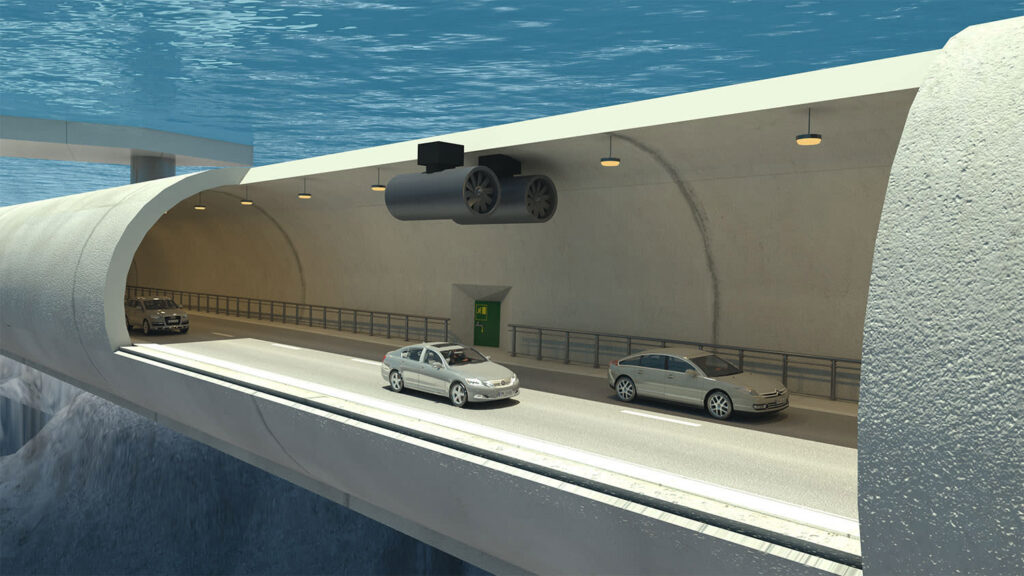
Imagine driving through a tunnel that floats inside the water rather than running beneath the seabed. No deep drilling through bedrock, no bridge towers reaching into the sky. Just a concrete tube suspended in the middle of a fjord, with ships passing overhead and fish swimming around its walls. This is not science fiction. Norway plans to build the world’s first submerged floating tunnel as part of an effort to reshape its west coast transportation network.
The Norwegian Public Roads Administration has been studying the concept for over a decade. If approved for construction, the structures would become a defining piece of one of Europe’s most ambitious infrastructure projects, valued at roughly 40 billion dollars.
How a Floating Tunnel Works
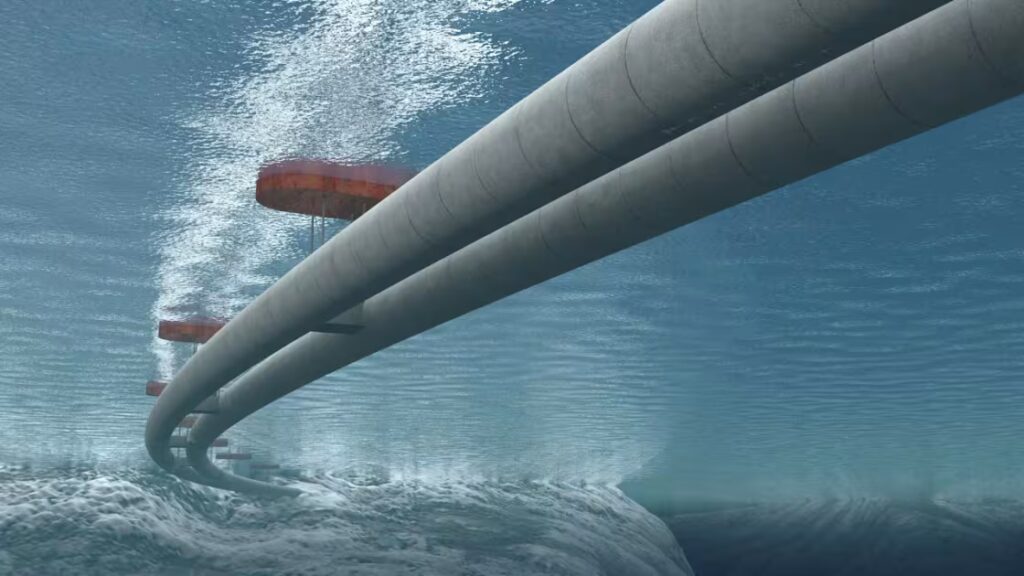
A submerged floating tunnel, also called an Archimedes bridge, is a hollow concrete tube positioned about 20 to 30 meters below the water’s surface. The tube is buoyant but not actually floating freely. It stays in place through cables anchored to the seabed, pontoons resting on the surface, or a combination of both.
The depth matters. Sitting 30 meters underwater puts the tunnel below the reach of waves, weather, and most ship traffic. At the same time, it stays shallow enough to avoid the extreme pressure that affects deep submarines. The interior would feature two lanes of traffic, with separate lanes for emergencies and maintenance.
Why Norway Needs This
Norway’s west coast has more than 1,000 fjords, many too deep for traditional tunnels and too wide for bridges. The country’s main coastal highway, the E39, currently runs from Kristiansand in the south to Trondheim in the north and requires seven ferry crossings along the way. The full 1,100-kilometer journey takes about 21 hours.
The Norwegian government wants to cut that time in half through a project called “Ferry-Free E39.” The plan combines suspension bridges, floating bridges, conventional tunnels, and submerged floating tunnels to create a continuous road. Each crossing method is matched to the geography of a specific fjord. The SFTs would handle the locations where nothing else works.
The Engineering Challenge
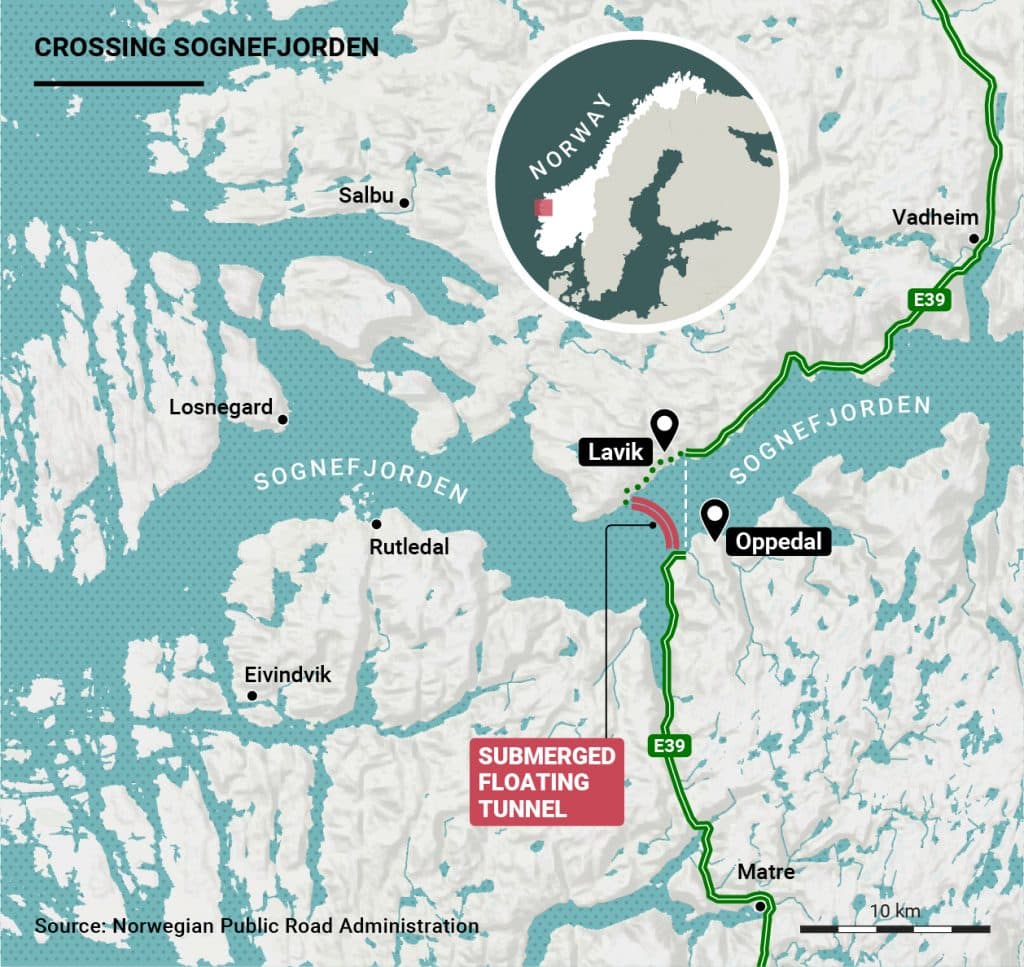
Sognefjord, one of the proposed sites, illustrates the problem. The fjord is 1,250 meters deep and 3.7 kilometers wide. A standard subsea tunnel would require drilling far below the seabed at impractical depths. A bridge would need towers anchored to a seabed too deep to reach.
A feasibility study by the Reinertsen Olav Olsen Group proposed crossing Sognefjord with two parallel concrete tubes, each 3.7 kilometers long, supported by 16 pontoons spaced at least 400 meters apart to let large ships pass. Construction would require 400,000 cubic meters of concrete and 61,000 cubic meters of steel. The estimated cost reaches 25 billion dollars for this single crossing, with a construction timeline of seven to nine years.
The Race to Build the First One
Norway is not alone in researching this technology. Italy, China, and South Korea are working on similar projects, each hoping to be the first country to actually build one. The concept itself is old. British naval architect Edward Reed proposed a floating tunnel across the English Channel in 1882, but the idea went nowhere for over a century.
Modern offshore engineering changed that. The same techniques used for oil platforms and underwater pipelines made the structures plausible. Researchers from Norway have collaborated with Italian engineering firm Ponte di Archimede International, the Danish Road Institute, and the Italian Shipping Register, with funding from the European Union. The Norwegian government has tested how the tunnels would withstand explosions, submarine collisions, and extreme weather.
When You Might Drive Through One
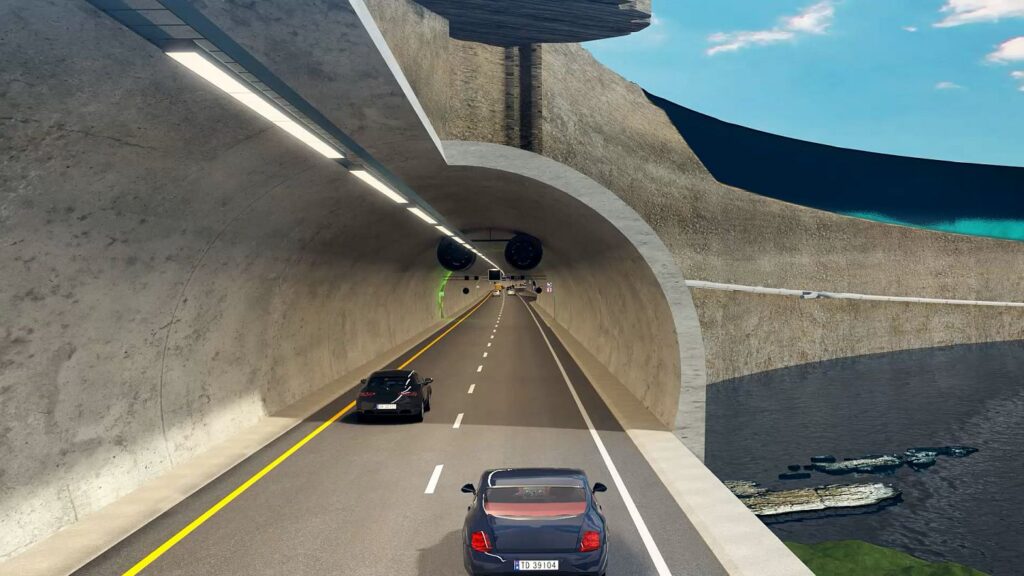
The Norwegian Public Roads Administration aims to complete the broader E39 project by 2050. Some portions are progressing faster than others. The Rogfast tunnel, a conventional rock tunnel under the Boknafjord, is currently under construction and expected to open in 2033. At 27 kilometers long and 392 meters deep, it will become the world’s longest and deepest subsea road tunnel when finished, but it is not a floating tunnel.
The first actual SFT remains a proposal. A final decision on the Sognefjord crossing has not been made, and construction has not been approved. If everything goes forward, drivers could pass through the world’s first submerged floating tunnel sometime in the 2040s. By then, the idea of driving through a giant concrete straw suspended in the middle of a fjord might feel almost ordinary.